Since the dawn of time, yellow has been synonymous with light and energy, found in ancient Iranian symbolism and, most famously, in the paintings of Vincent Van Gogh. In our new photographic book In viaggio nei colori (Travelling in colour), we have collected 400 photographs dedicated to 12 fundamental colours, and there is no doubt that those linked to yellow, as well as the experiences that allow one to experience them, are the most luminous and palpitating with energy.

Sunflowers in Languedoc © Paul Atkinson / Shutterstock
Languedoc-Roussillon, France
The valleys of western Provence and Languedoc-Roussillon, stretching between the Pyrenees and the Alps, seem to bask in the sun. In the undulating hills south of Castelnaudary, where fields of sunflowers follow one another as far as the eye can see, one has the impression of swimming in a sea of yellow flowers that - in homage to their name - follow the movement of the sun throughout the day.
Travelling in colours

Convento de San Antonio de Padua © emperorcosar / Shutterstock
Izamal, Mexico
Izamal, a small town in Yucatán, is famous for its bright yellow buildings. The most interesting is the Convento de San Antonio de Padua, which stands in the heart of the ciudad amarilla (the yellow city), built by the Spanish in the 16th century using the stones of a Mayan temple, the pyramid of Ppapp-Hol-Chac, which they had destroyed

Horned box fish © basicdog / Shutterstock
Îles Tuamotu, French Polynesia
This creature with a yellow livery dotted with white, called the horned box fish because of its four bony outgrowths, is easy to observe in coral lagoons and river mouths from the Red Sea to Australia. The 77 beautiful atolls of the Îles Tuamotus, the largest chain of atolls in the world, are perfect for admiring this fish.
Subscribe to our newsletter! For you weekly travel tips, special offers, stories from the world and 30% discount on your first order.

Berber gate in the Moulay Ismail mausoleum © MRMPICS / Shutterstock
Meknès, Morocco
Worthy of a sultan whose family descended from the prophet Muhammad, the mausoleum of Moulay Ismail is one of the highest expressions of Moroccan craftsmanship. In 2016, restoration work began that should return it to its former glory. In the meantime, the narrow, winding streets and majestic buildings of the medina are worth a visit.

Palácio Nacional da Pena, Sintra © Balate Dorin / Shutterstock
Sintra, Portugal
The imposing Palácio Nacional da Pena in Sintra, built in the 19th century as a summer residence for the royal family, stands in a magnificent position on a rocky outcrop. The vivid colours of the exterior were restored in 1996 according to the original design, and on a clear day the palácio can easily be seen from Lisbon.

Rotterdam, the cube houses of Piet Blom © JJFarq / Shutterstock
Rotterdam, Netherlands
It is hard to imagine living in the cubic houses with 54.7 degree sloping walls designed in the 1970s by Piet Blom. According to the famous architect, they should represent the trees of an artificial yellow forest. The Show Cube Museum and the Stayokay hostel offer a glimpse inside these strange dwellings.
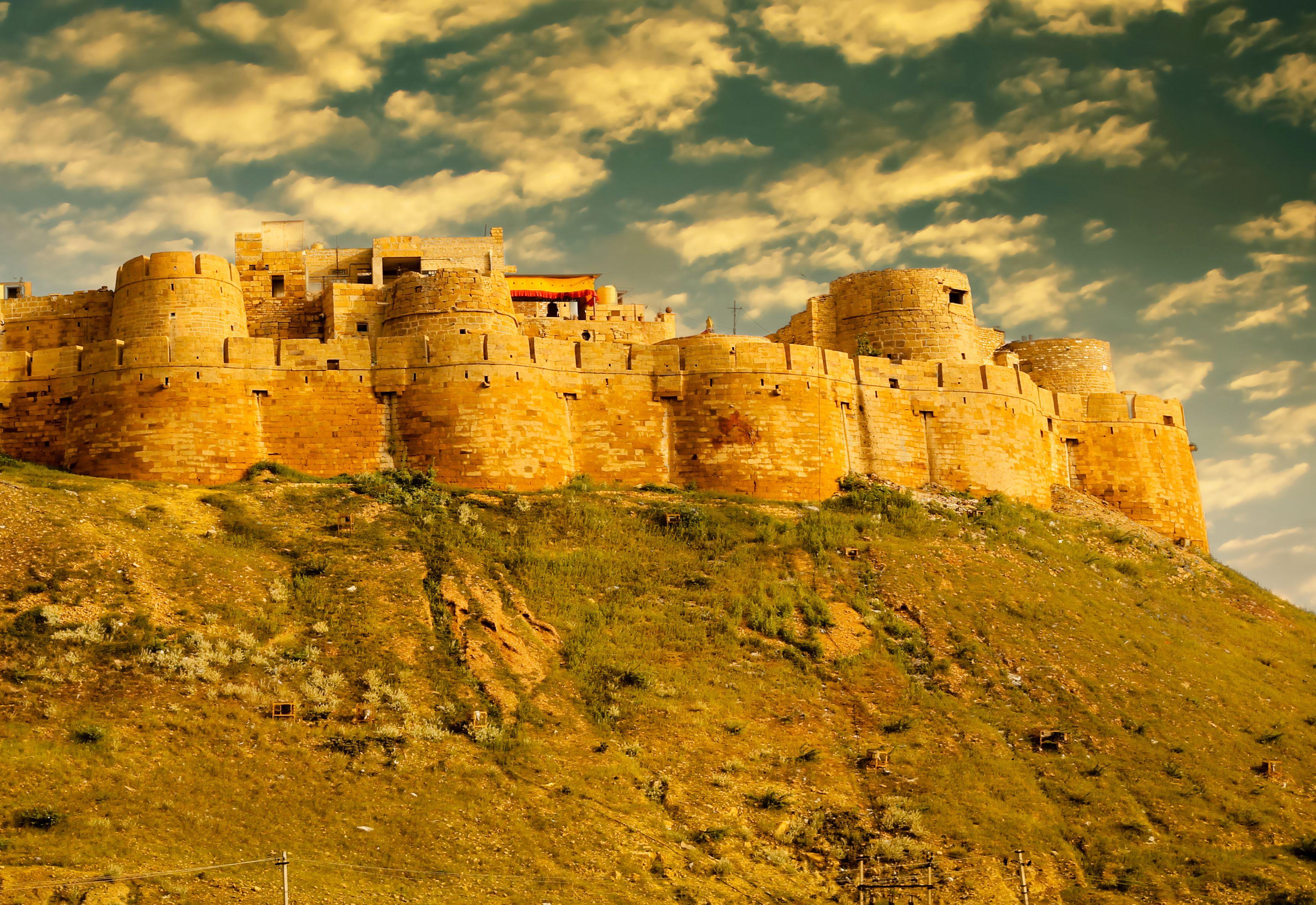
The Jaisalmer fort © Pinkcandy / Shutterstock
Jaisalmer Fort, India
From a distance, the Jaisalmer Fort, built of honey-coloured sandstone, looks like a gilded (and very elaborate) sand castle towering in the Thar desert in western Rajasthan. But this is no sand castle destined to crumble at the first rainstorm: in the Sonar Quila, or golden fort, as it is called, live three thousand people.

Madeleines, fluffy and inviting © AS Food studio / Shutterstock
Commercy, France
Known to literary enthusiasts the world over, the madeleine, which evoked memories of the past in Marcel Proust, is still handcrafted in the Boîte à Madeleines in Commercy, Lorraine, where it is said that the commercial production of this small, fluffy, shell-shaped treat began more than 250 years ago.

Ascensor da Glória © Marcin Krzyzak / Shutterstock
Lisbon, Portugal
The Ascensor da Glória, or Elevador da Glória, is a must in the city - not least because the alternative, walking uphill, is extremely tiring. Connecting Praça dos Restauradores, in the centre, with Rua São Pedro de Alcântara, in the Bairro Alto, it is the most popular funicular among tourists, not least because the views along its route are wonderful.

Tortellini, yellow gold © FPWing / Shutterstock
Bologna, Italy
Bologna and Modena have always claimed the invention of tortellini, but in the capital of Emilia, known as 'la Grassa' (for its cuisine), tortellini are sublime in shape and taste. Order them in broth, as tradition dictates, at Trattoria Gianni, or go to Paolo Atti e Figli and take home one of the beautiful packages of his inimitable tortellini.