The image most often associated with Copenhagen is that of the colourful buildings and masts of sailboats that line the sparkling waters of Nyhavn. This beautiful and popular place is located in the central district, Indre By ('inner city'), and is undoubtedly the area with which visitors are most familiar. But move a little further away from Nyhavn and you can discover the city's other eclectic neighbourhoods, each with its own distinct personality.

The colourful Nyhavn at night © SeanPavonePhoto / Getty Images
Indre By: the tourist hub
The central area is the heart of Copenhagen and the most visited district of the city. Nyhavn is just one of its many attractions, but there are also the Tivoli Gardens amusement park, Strøget, a lively pedestrian shopping area, and the famous Little Mermaid statue, located right on the edge of the centre.
This historic district is a great place to explore the city's many cobbled streets, charming squares and excellent museums. At the royal residence of the Amalienborg Slot, visitors can watch the changing of the guard and perhaps try to catch a glimpse of the queen, while the Christiansborg Slot offers an insight into the workings of the Danish monarchy and government.
Indre By is also a paradise for food lovers. It is home to many of the city's best restaurants, including the Michelin-starred AOC and Kokkeriet, the more modest but fabulous Høst and Uformel, as well as the Torvehallerne, a magnificent market packed with fresh produce vendors.
This is certainly not a place where it is easy to stray off the beaten track, but the rich offer of sights, tastes and experiences of this lively neighbourhood, combined with its lively atmosphere, make Indre By a must-visit destination for all visitors.

Vesterbro is a great place to stroll around the open-air markets © Caroline Hadamitzky / Lonely Planet
Vesterbro: the hub of the trendy scene
Vesterbro, once the seediest area of the city, is still Copenhagen's red-light district, but it is not as shabby as similar versions in Amsterdam or Berlin. Vintage shops and summer open-air markets give the neighbourhood a local, independent feel, while its street art is perhaps the most beautiful in the city.
Vesterbro is a neighbourhood in transition, which is making a name for itself for its good restaurants and family-friendly destinations. In between the sex shops and lap dance clubs are trendy cafés like Mad & Kaffe, craft breweries like the popular Mikkeller and popular family parks like Skyebanehave. Kødbyen - the Meatpacking District - is packed with fantastic restaurants ranging from the innovative seafood cuisine of Kødbyens Fiskebar to simple beer barbecues at WarPigs.
Nørrebro: the multicultural district
The lively Nørrebro is located just across the Queen Louise Bridge from Indre By, but has a completely different atmosphere. The streets of Nørrebro, which is probably the most diverse neighbourhood in Copenhagen, are a hodgepodge of shops selling ethnic food, clothing and second-hand articles alternating with independent cafés.
The gastronomic offerings range from the Michelin-starred restaurants Relæ and Kiin Kiin to the noodles of Ramen to Biiru (ramentobiiru.dk) and the pub food of the Nørrebro Bryghus microbrewery. Ethnic cuisine is also well represented, with places like Ma'ed Ethiopian (facebook.com/Maed-Ethiopian-Restaurant) and the legendary Kebabistan on Nørrebrogade.
Jægersborggade, once the haunt of bikers and drug dealers, is now home to quirky shops selling everything from ice cream to liquid nitrogen to cacti, while Ravnsborggade offers inviting vintage boutiques and antique shops.
The Assistens Kirkegård is not only the cemetery where illustrious Danish personalities such as Hans Christian Andersen and Søren Kirkegaard are buried, it is also a beautiful park, perfect for a peaceful walk in the green. The multicultural atmosphere and sense of community are particularly evident at Superkilen, a picturesque and unique urban park featuring sculptures and elements from all over the world whose aim is to celebrate diversity and international spirit.
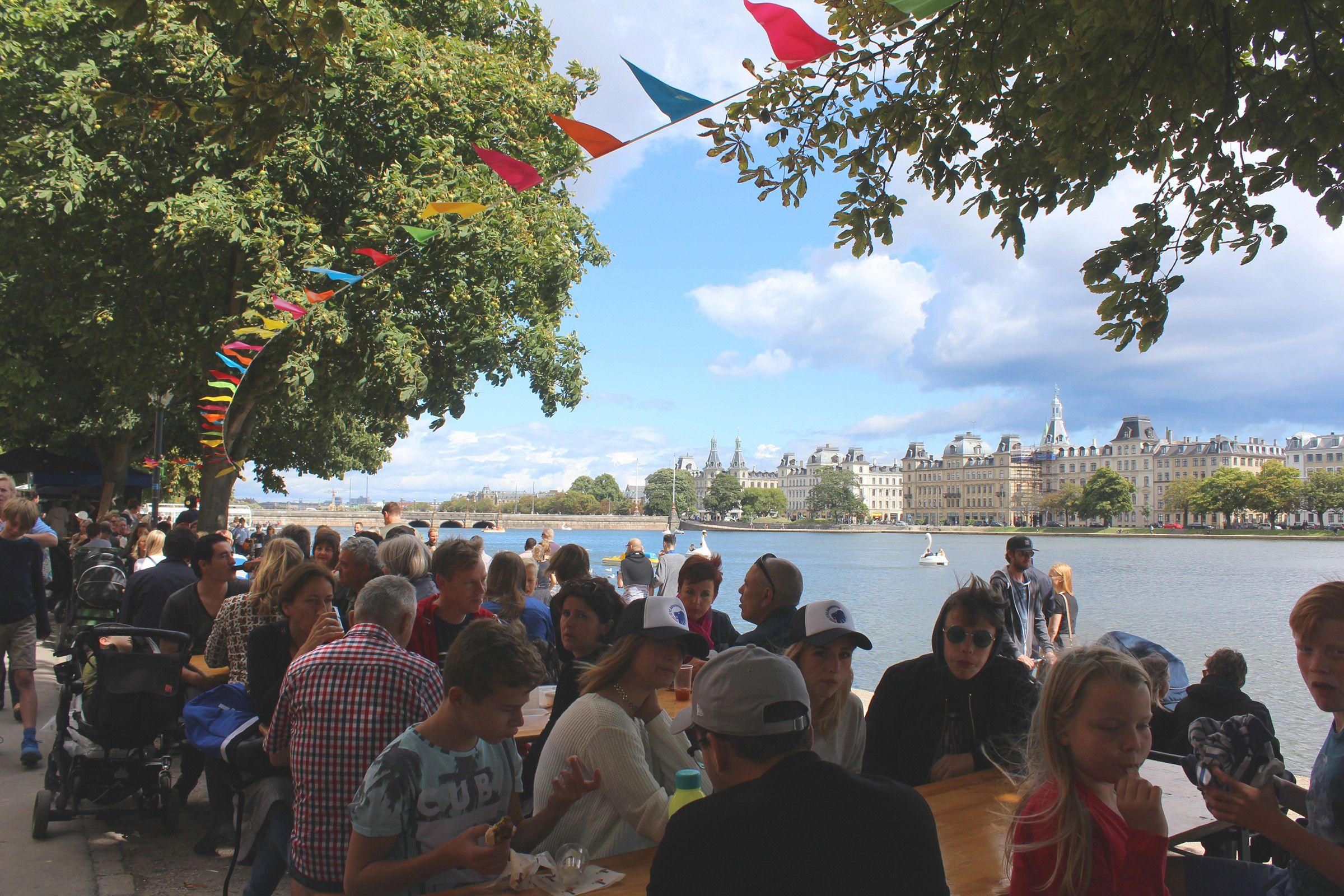
Locals at a street food festival on the shores of the Copenhagen lakes in Nørrebro © Caroline Hadamitzky / Lonely Planet
Østerbro: life in the suburbs
The bourgeois neighbourhood of Østerbro, the least touristy of Copenhagen's main districts, is a great place to get a feel for local life. Predominantly residential, Østerbro offers an escape from the tourist crowds while offering a wide choice of restaurants, shops and outdoor activities. The main street, Østerbrogade, is packed with upmarket boutiques such as Normann Copenhagen, as well as cafés and coffee shops, including a branch of the fabulous Grød, a porridge joint.
The spacious Fælledparken is a green oasis next to the Parken Stadium (parken.dk), the city's multifunctional stadium complex inside which, in a highly unusual location, is Denmark's only three-Michelin-starred restaurant, the Geranium. Get a feel for the area by taking a walk along the easternmost of Copenhagen's lakes or admiring the colourful houses of Brumleby and Olufsvej.
Sign up for our newsletter! For you weekly travel tips, special offers, stories from around the world and 30% discount on your first order.
Christianshavn: the charm of the island
The picturesque canal on this artificial island in the centre of Copenhagen is inspired by Amsterdam, and with boats moored along the banks it gives the area a maritime feel. In summer, locals sit along the water's edge to enjoy a picnic or a cold drink, while the more adventurous tackle the 400 steps of the spiral staircase leading to the top of the golden spire of the Church of Our Redeemer to admire the beautiful view over the city. Christianshavn is also home to the ultra-modern Copenhagen Opera House, located on the other side of the harbour from the Amalienborg Slot.
A completely different place is the free city of Christiania, a 34-hectare area with a commune founded in 1971.
The infamous Pusher Street, with its hashish market, is perhaps Christiania's most famous element, but the whimsical 'do-it-yourself' houses, artists' studios and the natural beauty of the place lend a certain charm to this non-conformist lifestyle.
Christianshavn's gastronomic scene is as eclectic as its inhabitants: it boasts three Michelin-starred restaurants, as well as the famous Noma, and a fantastic range of street food. Just across the bridge from Nyhavn is The Bridge Street Kitchen, while a little further down Refshaløen is Reffen, with over 30 kiosks offering a wide variety of cuisines.

Visit the free city of Christiania to discover a non-conformist lifestyle © Caroline Hadamitzky / Lonely Planet
Frederiksberg: the elegant district
Although located within the Copenhagen area, Frederiksberg is technically a municipality in itself. This elegant area, which can be reached from Vesterbro by taking the tree-lined Frederiksberg Alle boulevard, offers beautiful residential buildings and green spaces and is one of the most desirable neighbourhoods for families.
There are many elegant shops and cafés in the area, including Bertels Salon (bertelskager.dk), which prides itself on serving the best cheesecake in the city. Frederiksberg is also home to top restaurants such as the Michelin-starred French restaurant Formel B (formelb.dk) and Mielcke & Hurtigkarl. The latter serves a highly original menu of Asian-inspired New Nordic cuisine using locally sourced seasonal ingredients, including herbs from their own garden and homegrown honey.
The highlight of the neighbourhood, however, is Frederiksberg Have, a vast park that includes an 18th-century palace, a Chinese pavilion, a heron colony and an area overlooking the adjacent Copenhagen Zoo from which you can watch elephants. Beyond the zoo is Søndermarken, a green space with the Cisternerne below, a former water reservoir where art exhibitions are now held.

A fountain in elegant Frederiksberg © Caroline Hadamitzky / Lonely Planet