Food is one of the most direct expressions of a culture. That's why more and more often when we visit a place we don't just want to see it, we want to taste it: from street food stalls to avant-garde restaurants, whether it's a spicy dish or a wine tasting, here are the 8 countries where we eat and drink best in the world. Places to visit if you are looking for delights for the palate.

The world's most famous bubbles in Epernay, France. ©stocknshares/Getty Images
1. Plzeň, Czech Republic
For all beer lovers, Plzeň (Pilsen in German) is the home of lager, the fountain of eternal froth, the place where, in 1842, Pilsner Urquell, considered the first and finest lager in the world, was invented. The original Pilsner Urquell brewery (German for 'original source', prazdroj in Czech) attracts an enthusiastic public from all corners of the globe.
Bohemia's second largest city after Prague and, in 2015, European Capital of Culture, in addition to the beautiful main square and ancient network of underground tunnels it has much to offer children: the Techmania science centre, the zoo and the Puppet Museum. The distance from Prague would make it possible to visit Plzeň in one long day trip, but it is much more appreciated by staying overnight.
2. Champagne, France
The whole world knows the great champagne brands of Reims and Épernay, the two main centres of the region. But our advice is to try the one produced by passionate vignerons in their small wineries located in fabulous villages. The best way to taste the delicious 'liquid gold' is to drive on scenic roads through the rolling vineyard-covered hills of one of the best-known wine regions in France.

Traditional Danish smorrebrod. ©Maridav/Shutterstock
3. Copenhagen, Denmark
Copenhagen is one of Europe's best gourmet destinations, with more Michelin stars than any other Scandinavian city. The local specialities not to be missed are numerous:
- Beer. Carlsberg dominates the market, but there is a growing battalion of microbreweries (including Mikkeller, Amager Bryghus and Bryghuset Møn).
- Kanelsnegel. Better not count calories: the 'cinnamon snail' is a buttery brioche, sometimes variegated with chocolate.
- Koldskål. A mixture of eggs, sugar, buttermilk and yoghurt flavoured with vanilla served cold, usually with crispy biscuits such as kammerjunkere.
- New Nordic. Only local products, prepared with revolutionary creativity in top Copenhagen restaurants such as Noma, Kadeau or Geranium.
- Sild. Smoked, cured, pickled or fried, herring is a Danish classic. It is usually accompanied by a generous sip of akvavit (caraway-flavoured potato distillate).
- Smørrebrød. Sandwiches made of rye or wheat bread stuffed with various ingredients - from beef tartar to eggs to shrimp - are Denmark's most famous export product.

A chef at work in Shinjuku Golden Gai, Tokyo. ©Khaikholun Vaiphei/Shutterstock
4. Japan
Attention to detail, care and creativity in presentation and the finest ingredients produce memorable cuisine. Forget what you know about Japanese cuisine and embark on a gastronomic adventure like no other. Here are some of the specialities to try during a trip to Japan.
- Okonomiyaki. A kind of omelette made of shredded cabbage and more cooked on a hot griddle.
- Sake. Many still consider it the national drink; it perfectly accompanies traditional Japanese cuisine.
- Shabu-shabu. Thin slices of marrow and vegetables cooked in a light broth and then dipped in sauces.
- Tonkatsu. Breaded pork cutlets served with a special sauce, usually part of a set menu(tonkatsu teishoku).
- Unagi. Eel is an expensive delicacy in Japan.
- Yakitori. Skewers of grilled chicken and vegetables.
To avoid making mistakes or ordering, it is certainly helpful to know a few phrases in Japanese.
Sign up for our newsletter! For you weekly travel tips, special offers, stories from the world and 30% discount on your first order.
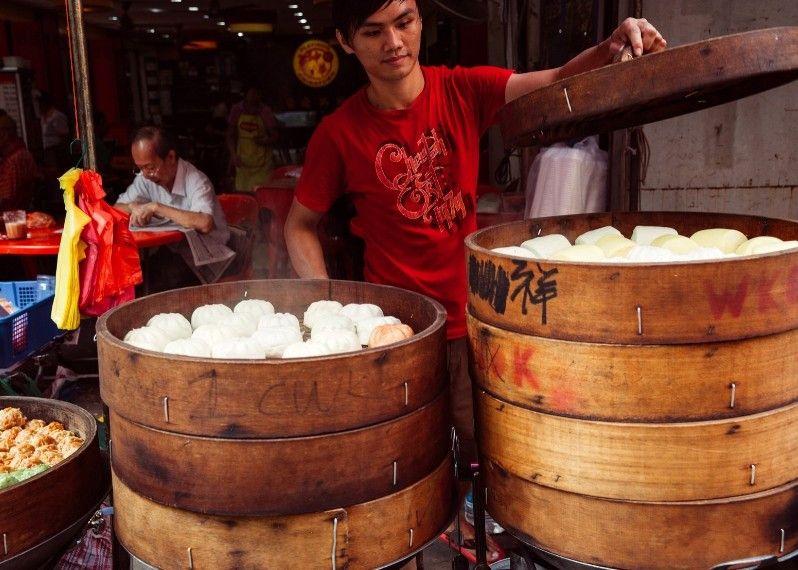
In Kuala Lumpur, Malaysia you will find street food from different cultures. ©Elena Ermakova/Shutterstock
5. Malaysia
Malaysia offers visitors humid jungles inhabited by wild animals, beautiful beaches, idyllic islands and sensational cuisine linked to its multi-ethnic culture.
If there is one thing that unites all ethnicities, religions and landscapes, it is, in fact, the cuisine. In Malaysia, the best food is that prepared in the simplest of places. The seemingly endless hawkers serve delicious specialities in carts, stalls and shophouses, many of them according to recipes handed down through generations. You will be spoilt for choice: between Nonya, Indian, Chinese, Malay and Dayak specialities, as well as some excellent examples of Western cuisine, travellers will certainly not go hungry!

The traditional Pintxos of San Sebastian, Spain. ©Matyas Rehak/Shutterstock
6. San Sebastián, Spain
Local chefs have turned bar snacks into an art form. Often referred to as 'haute cuisine in miniature', pintxos (Basque tapas) are mounds of flavour atop slices of baguette. Walk into any of the bars in the centre of San Sebastián and the choice on display on the counter leaves you speechless. In short, this will be the most memorable gastronomic experience of your trip. Although the atmosphere is always informal, the Basques take experimenting with new flavour combinations very seriously, guaranteeing top quality at all times.

It's hard to choose between flavours from Turkey: kebabs, meze, sweets and tea. ©Matt Munro/Lonely Planet
7. Turkey
The best thing about sampling the specialities of Turkish cuisine - from mixed meze dishes in a Mediterranean harbour to breakfast in your guesthouse with fresh ingredients from the home garden - is that it introduces you to the heart of the country's culture, which is essential for a perfect trip. For the Turks, who love to be with friends and family, eating together is a long-standing ritual.
So stop and enjoy the olive-oil seasoned vegetables from the Aegean coast, the spicy Anatolian kebabs and the specialities from every other corner of the country - and as you drink a çay (tea) from a tulip-shaped glass and choose baklava for dessert, remember that you are deepening your knowledge of Turkey.

Traditional Pho sold directly from a boat, Vietnam. ©hadynyah/Getty Images
8. Vietnam
Complex and refined, Vietnamese cuisine uses local and seasonal ingredients and is perhaps Asia's best-kept culinary secret. What counts is the freshness of the ingredients: chefs go to the market twice a day to choose freshly picked herbs. The result? An incomparable structure of dishes, with unique combinations of flavours.
In Vietnam, every meal must balance the sour with the sweet, the crispy with the soft, the fried with the steamed, the soups with the salads. You will find delicious local specialities everywhere: the 'white rose' of Hoi An, the canh chua (fish soup with vegetables) of the Mekong Delta or the classic pho (soup) of the north.